
China–Thailand High-Speed Rail Project Advances, Targeting First-Phase Operation by 2030 to Boost ASEAN Economy and Trade
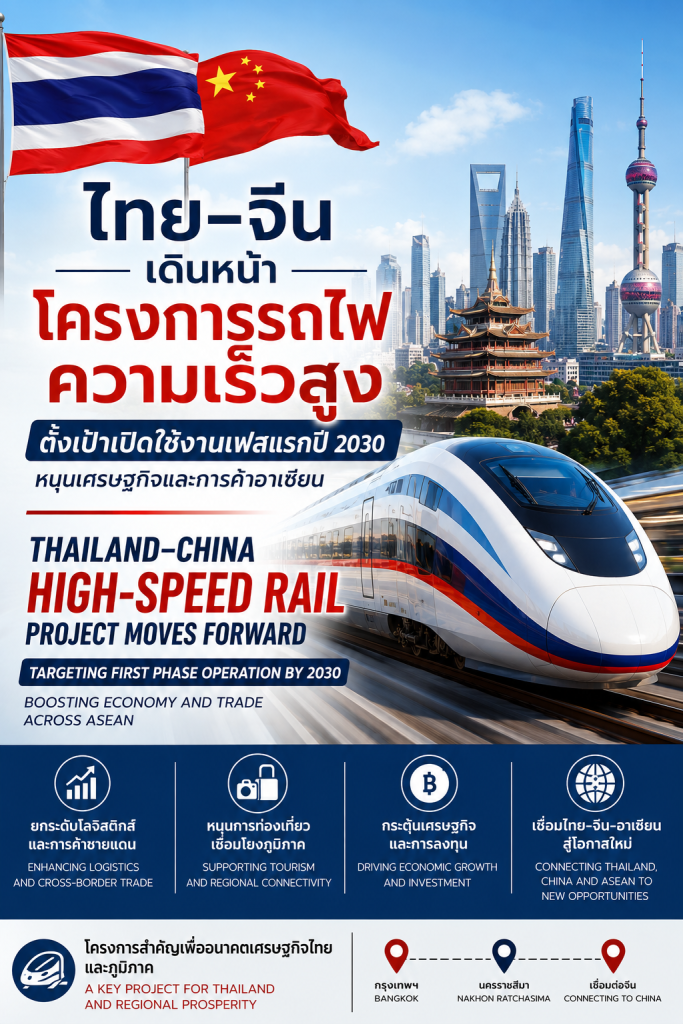
Thailand and China continue to strengthen their cooperation in infrastructure development. Recently, the Thai government reaffirmed its commitment to accelerating the construction of Phase 1 of the Thailand–China High-Speed Rail Project, connecting Bangkok and Nakhon Ratchasima, with the goal of commencing operations by 2030. The project is regarded as one of the region’s key strategic infrastructure initiatives.
The railway, spanning approximately 250 kilometers, forms part of the broader Kunming–Laos–Thailand railway network, which aims to enhance connectivity and improve the efficiency of passenger and freight transportation between China, Thailand, and ASEAN countries.
Enhancing Logistics and Cross-Border Trade
The development of this rail infrastructure is expected to significantly reduce logistics costs, improve transportation efficiency, and support the expansion of cross-border trade. This is particularly important for agricultural products, food, and industrial goods traded between Thailand and China, with China remaining one of Thailand’s largest trading partners.
Furthermore, the high-speed rail project is expected to support the development of special economic zones and attract investment along the railway corridor, creating new business opportunities, employment, and increased foreign direct investment.
Supporting Tourism and Regional Connectivity
Beyond economic benefits, the Thailand–China High-Speed Rail will also strengthen the tourism sector by facilitating travel for tourists from Thailand, China, and neighboring ASEAN countries. The project is expected to promote seamless regional travel and deepen people-to-people connectivity across the region.
Many experts believe that once completed, the railway will help position Thailand as a regional transportation and logistics hub while serving as a significant driver of long-term economic cooperation between Thailand and China.
New Opportunities in an Increasingly Connected Economy
The advancement of the Thailand–China High-Speed Rail Project is not merely an infrastructure initiative but also a reflection of the strategic partnership between the two nations. The project aims to foster shared economic growth through deeper cooperation in trade, investment, technology, and sustainable regional development.
If completed as planned by 2030, Thailand is expected to play an increasingly important role as a gateway connecting China with ASEAN, while emerging as one of Southeast Asia’s leading logistics and transportation centers.
Credit: https://shorturl.at/R2jMS